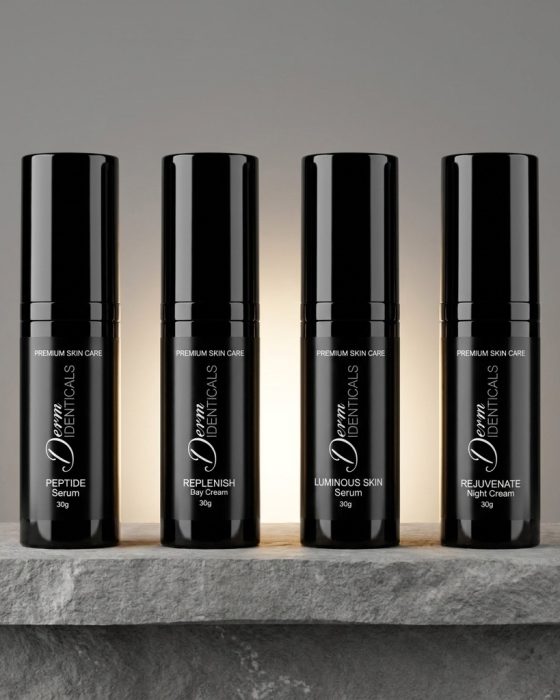
Vitamin C is a powerhouse ingredient in skincare, renowned for its antioxidant properties, ability to brighten skin, boost collagen production, protect against environmental damage like UV rays and pollution and can reduce hyperpigmentation (we recommend more effective ingredients for pigmentation). However, the pure form, L-ascorbic acid, is unstable and irritating. To address these issues, cosmetic chemists have developed various derivatives that offer improved stability, better penetration, and reduced irritation while still delivering many of the benefits of Vitamin C. Several of the most common forms are discussed below including advantages and disadvantages of each.
(1) L-Ascorbic Acid (Pure Vitamin C)
L-Ascorbic acid is the biologically active form of Vitamin C and the most researched in skincare. It’s water-soluble and highly potent, providing strong antioxidant protection, brightening effects by inhibiting melanin production, and collagen synthesis to reduce fine lines. However, its instability is a major drawback—it oxidizes quickly when exposed to air, light, or heat, turning products yellow or brown and reducing efficacy. It requires a low pH (around 3.5) for stability and to be able to absorb through the skin which can irritate sensitive skin, causing redness or stinging. It has low transdermal absorption (even at the correct pH) with some sources indicating only around 1% is absorbed which is why high concentrations are often used to be effective. Due to the low pH, skin irritation and potential disruption of skin barrier function with continual use we prefer to other forms of which are less irritating on the skin.
(2) Ethyl Ascorbate (3-O Ethyl Ascorbic Acid
This derivative modifies ascorbic acid with an ethyl group, making it more stable and soluble in both water and oil. Being more oil soluble it penetrates the skin more efficiently (so lower strengths are effective) and then converts to L-ascorbic acid once absorbed, offering antioxidant, brightening, and collagen-boosting benefits. Studies show it may outperform ascorbyl glucoside in penetration, and it’s less irritating than pure ascorbic acid. It’s stable at a neutral pH which is a major advantage and does not irritate the skin. For these reasons this one of our preferred forms of Vitamin C and used in many of our Products.
(3) Ascorbyl Glucoside
A stable, water-soluble derivative where ascorbic acid is bound to glucose. It converts slowly to L-ascorbic acid in the skin via enzymes, creating a “reservoir effect” for prolonged benefits. It’ has in vitro evidence for antioxidant activity, melanin reduction, and collagen promotion. It is gentle on the skin so good for sensitive skin types and useful for anti-aging and skin brightening.
(4) Ascorbyl Tetraisopalmitate (Tetrahexyldecyl Ascorbate or THD Ascorbate)
This oil-soluble form esterifies ascorbic acid with fatty acids, enhancing penetration into deeper skin layers so more effective at lower concentrations. It’s highly stable, doesn’t require low pH and thus non irritating to skin barrier function, and converts to ascorbic acid in the skin. Research indicates strong anti-aging effects, including collagen stimulation and UV protection, with minimal irritation. Again this is another favorite used in our products.
(5) Other Notable Forms
Sodium Ascorbyl Phosphate (SAP): A water-soluble, stable derivative ideal for acne-prone skin due to its anti-inflammatory and antibacterial properties. It converts to ascorbic acid and helps with brightening and collagen, but is less potent and being an ionic compound it is not absorbed as well as other forms.
Magnesium Ascorbyl Phosphate (MAP): Similar to SAP but even gentler, with good stability at neutral pH. It’s effective for hyperpigmentation and elasticity, making it suitable for sensitive skin but less potent and not as well absorbed as other forms.
Ascorbyl Palmitate: An older, fat-soluble form used as a preservative. It’s stable but poorly penetrates and converts inefficiently to ascorbic acid, limiting its benefits.
Glyceryl Ascorbate: A newer hydrated derivative combining ascorbic acid with glycerin for added moisturization. It shows promise in stability and user experience but has less research.
Due to various limitations listed in this group we do not use any of these forms of Vitamin C in our range.
In summary pure L-ascorbic acid offers results but only at high concentrations and low pH due to poor absorption causing irritation that potentially can disrupt barrier function more lipid soluble derivatives like ethyl ascorbate and ascorbyl tetraisopalmitate are used which provide a balance of efficacy, stability and gentleness, while options like ascorbyl glucoside are ideal for sensitive users. These are considered the best forms of Vitamin C and the ones you will find in our skin care range.